About the artist, icons & egg tempera painting
Alina Smolyansky: Icon painter, egg tempera artist, educator
My journey into icon painting began unexpectedly in 2008. At the time, I was researching an article about different spiritual paths when I encountered an image of an icon painted by Andrei Rublev. Although I was already familiar with icons and was on a spiritual path myself, something about that particular image affected me deeply and prompted me to look at icon painting in a completely different way.
By pure chance, I found a Byzantine icon painting class with a master iconographer. I saw it not only as a unique art class, but also as an opportunity for deep personal growth. Over the next three years, I studied both the ancient techniques of icon painting and the religious and sacred texts that provide the context for the images. I then continued developing my practice independently, studying iconographic examples, refining my understanding of egg tempera painting, and deepening my own practice of prayer and meditation. I also began teaching icon and egg tempera painting in small private groups.
Today, I continue to paint commissioned icons and offer selected classes and private tutoring.
My Approach to Icon Painting
For me, an icon is both a work of art and a devotional image. Its meaning is inseparable from the subject it represents and from the tradition in which that subject has been depicted.
When I work on an icon, I begin with research into the saint, feast, or sacred event being represented and look at historical examples to understand how the image has developed over time. This is particularly important when working on a commission, where the subject may be less commonly represented or where several established elements need to be brought together in a particular composition.
The painting itself is a slow and attentive process. I begin each commission with prayer and approach the work with a quiet, focused mind. As I paint, my attention remains on the subject and its meaning rather than simply on producing a finished object.
My technical approach is rooted in the Byzantine icon-painting tradition. I work with wooden panels, gesso, pure powdered pigments, egg tempera, and gold leaf, developing the image gradually through layers of paint. You can read more about the materials and techniques I use below on this page.
Teaching and Sharing the Practice
Teaching icon painting has been an important part of my development as an artist. Explaining the process to students has continually deepened my own understanding of the techniques, materials, and visual language of icon painting.
I enjoy helping students experience the particular qualities of egg tempera: its precision, transparency, luminous colour, and the patience required to build an image gradually. Some of my icon painting and egg tempera classes are available online.
What we created in our icon and egg tempera painting classes (some projects)
A Broader Artistic Practice
Although icon painting has been an important part of my artistic life, my work has also developed into other forms of symbolic and contemplative art. My interest has always been in the relationship between images, attention, meaning, and inner experience.
This is one reason I continue to value icon painting even as my broader artistic practice evolves. The discipline of working slowly, attentively, and with a strong connection to the subject continues to influence the way I approach art.
I hold a BA in Professional Communication from Royal Roads University and a diploma in Architecture. My background in communication and architecture has also influenced the way I think about images, composition, structure, and the relationship between an artwork and the person who encounters it.
My work is held in collections in Canada, the United States, Mexico, Peru, Germany, Great Britain, Australia, and Thailand.
I am based in Vancouver, Canada, and welcome commissions from around the world. My icon painting and egg tempera classes are available online.
“If my art inspires even one person toward higher spiritual goals, I consider my career a success.”
The Art of Egg Tempera and Byzantine Icon Painting
Egg tempera is an ancient painting medium that has been used for centuries in religious and secular art. It was particularly important in Byzantine and medieval painting and remains closely associated with Eastern Christian icon painting.
Egg tempera is made by mixing finely ground pigments with an egg-based emulsion. The paint dries quickly on an absorbent gessoed surface and is applied in successive layers, allowing the image to be developed gradually.
Unlike oil paint, which can be blended while wet, egg tempera is generally built up through small brushstrokes and layers of increasingly developed colour. The layers remain visually distinct while interacting optically, creating the characteristic luminosity and clarity of tempera painting.
Egg tempera is traditionally applied to a prepared wooden panel. The gesso provides a smooth, absorbent surface suited to the medium. Gold leaf may be applied to the halo, background, or other areas of an icon before the painting is completed.
I use natural pigments, egg tempera, wooden panels, gesso, and gold leaf in my icon painting. The materials are part of what makes the process so different from working with modern paints. The paint must be prepared in relatively small quantities, dries quickly, and cannot simply be stored indefinitely once mixed.
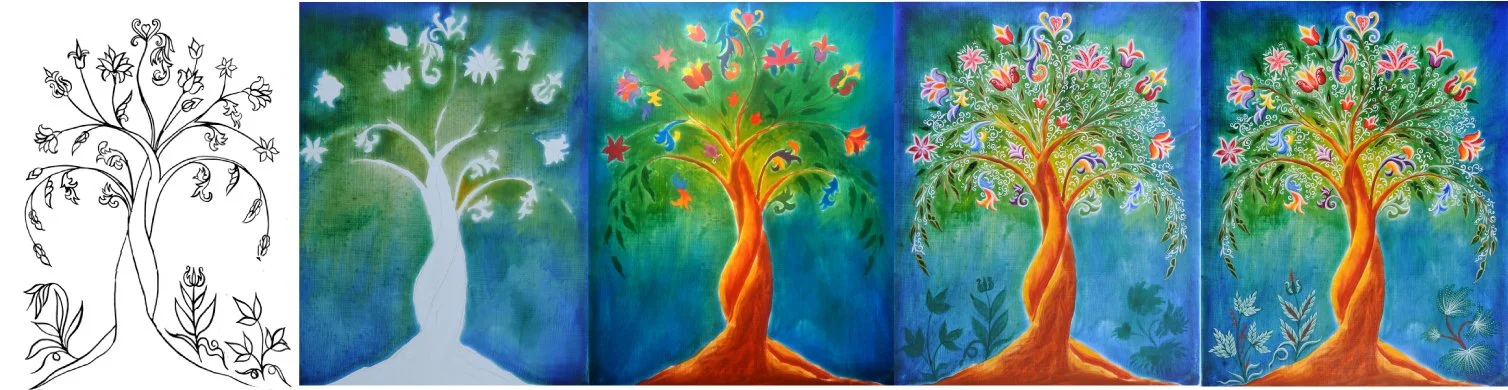
Progression of the Tree of Life from beginning to finished painting
Byzantine Icons and Icon Painting
An icon is a Christian sacred image representing a saint, a biblical event, or another subject from the Christian tradition. Icons have a particular place in Eastern Christian worship and personal devotion, and their imagery is developed within an established iconographic tradition.
For an icon painter, this means that the image is not simply an opportunity for unrestricted artistic interpretation. The composition, gestures, attributes, inscriptions, and other elements have meaning and are informed by established examples and theological tradition.
When I work on an icon, I study existing iconographic examples and, when necessary, research the saint or subject being represented. This is especially important when a commission involves a less commonly depicted saint, a particular historical version of an image, or a combination of established elements.
The painter's role is therefore different from that of an artist creating an entirely new image. The work involves both technical skill and careful attention to an existing visual and spiritual language.
The Icon Painting Process
An icon begins with a drawing and the preparation of the wooden panel. In earlier periods, icon painters worked from established iconographic patterns and painting manuals, which provided models for particular saints and compositions. Today, iconographers can study historical icons in books, museum collections, and other sources.
Once the composition has been established, the drawing is transferred to the prepared panel. Areas intended for gold leaf are prepared and gilded before the main painting begins.
The painting is developed gradually, usually beginning with the underlying colours and darker tones. The different areas of the composition are established first, including the landscape, architecture, clothing, and figures. The image is then progressively developed through lighter and more opaque layers.
In icon painting, forms are not generally modeled through realistic shading in the way they might be in naturalistic painting. Instead, characteristic highlights, lines, proportions, colours, and other conventions are used to develop the figures and communicate the particular visual language of the icon.
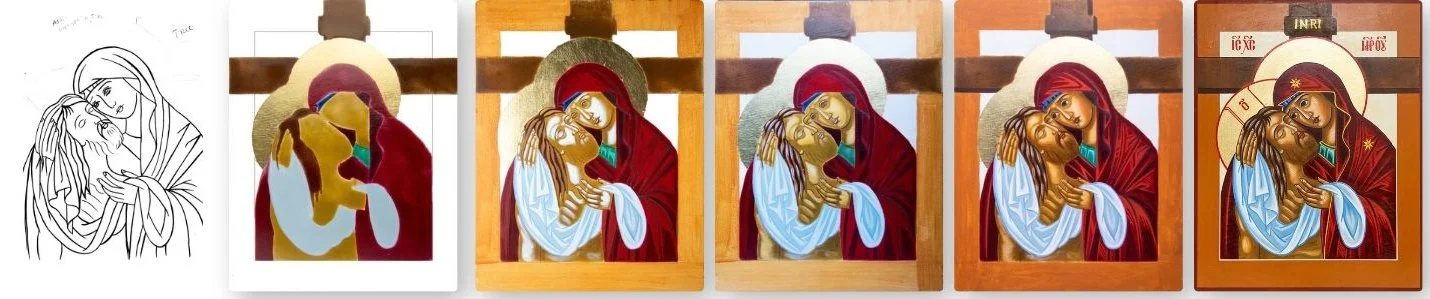
The Virgin Mary and Jesus Christ "Weep Not for Me, Mother", icon painting process.
Egg tempera can also be used in thin, transparent layers or glazes. Because each layer dries quickly, the painter cannot blend the paint in the same way as oil paint. Instead, colour and form are developed through the accumulation of many individual strokes and layers.
The final stages include the fine highlights and details, inscriptions, and any finishing work required for the particular icon.
One characteristic of traditional icon painting is that the iconographer does not normally sign the finished icon. The emphasis is on the sacred subject and the image itself rather than on the individual artist.
A Slow and Attentive Process
The technical process is only one part of why I continue to work with egg tempera and icon painting. I value the patience and concentration that the medium requires. The image develops slowly, one layer at a time, and the process encourages a particular quality of attention.
For my own work, painting an icon is also a devotional practice. I begin commissions with prayer and approach the work with quiet, focused attention.
For more information about commissioning an icon, please visit my Commissioning Icons page.